Showing posts with label World War II. Show all posts

Saturday, 15 August 2020

VJ Day

To remember my leaving to the Dutch Indies
As you know I have done research in my ancestry and I have found out so much over the years. Mostly ordinary stuff: birth-marriage-death, but on occasion I have found some more remarkable things. I won't brag too much about being from royal descent, after all, half of Europe can probably trace their lineage back to the great Charlie!

There was however one story which seemed to be different and at first I didn't in fact believe it. Especially as none in the family knew anything about it! After all, emigrating to Canada or the USA is one thing, dying in Indonesia is something completely different. Research was needed.

And what I found was extraordinary. A young man (1916) had to do his national service in the thirties. He did his basic training and was then allowed to go on grand leave (ie not having to return unless circumstances changed). But perhaps jobs were not to be had or he had enjoyed his time in the army, he decided to enlist properly. Enlist for the KNIL (Royal Dutch Indies Army). He was then sent out to what is now Indonesia to be a soldier there.

He had arrived before there was even a war in Europe, so probably felt quite safe in the far Dutch Indies. But in 1941 the Japanese attacked Pearl Harbor and soon after they invaded several countries in the Pacific area, one being the Dutch Indies. By early 1942 it was all over: the Dutch had surrendered and all military personnel had been captured and put in camps.

First Jan (that was his name) was put with his mates in a camp in the Dutch Indies, but was soon moved to Thailand by ship, which was a danger in itself. He survived the crossing however and was then put in a camp on the infamous railroad to Burma. Every so often the whole camp moved to keep up with the railroad.

Thanbyuzayat War Cemetery
Lack of food, lack of medical attention, humidity, heat, hard labour and most likely abuse by the Japanese caused Jan to contract Beriberi. A disease which even at that time was preventable as they knew the cause and the cure. But no cure was coming for Jan and on December 31, 1943 Jan passed away on the Thai/Burmese border. 


Thursday, 30 January 2020

Kamp Westerbork

'Frozen Tears'
Unless you are living under a rock or are totally not interested in our past: this/last week was the 75th anniversary of the liberation of Auschwitz. A few years ago, my sister and I visited that awful place. Another place we visited during that holiday was Kamp Westerbork in the Netherlands. A transit camp for Dutch Jews and Dutch Gypsies, who were sent to Sobibor, Auschwitz (both in Poland), Terezin (or Theresienstadt in Czechia) and later when the war started to turn to Bergen Belsen (Germany) which we also visited.

Yesterday I made my way back to Kamp Westerbork with a busload of 14 and 15 year olds. As part of their history lessons, they were going to get a tour of the camp. First they visited the small museum (which had a temporary exhibition about the Roma and Sinti gypsies in the Netherlands, next to the regular exhibition). After that they went to the camp itself, where they got a tour and more explanations.

The speaker, Mr Hans Peeper
translation of verse at the bottom
After lunch there was to be a guest speaker. A gentleman who had actually survived Bergen Belsen as a 6 year old boy. He was there to tell us (I asked whether I could join) about his life prior, during and after Bergen Belsen. He was only four when he and his family arrived in Westerbork and after a year there, they were sent to Bergen Belsen. It didn't have gas chambers, but there were too many people on too small an area, not enough food, not enough shelter and no medical care whatsoever. 

Even though he was only a small boy, he stayed with his father and only saw his mother once more, when they took him to see her on her death bed. His father got sick after that and he and his dad stayed in the 'sick quarters', which saved their lives most likely. As the Allied forces got nearer, the Nazis got more desperate and they loaded up a train to be sent on a wild goose chase to nowhere. Not long after that, the British arrived and liberated the camp. 

Mr Peeper told about his life after the war as well. He was by then six years old and he and his father made their way back to the Netherlands, where his father was nursed back to health. He didn't loose all of his family, as one aunt and uncle and their children had gone into hiding and had survived. All the others were killed. 

In the end he made a good life for himself, marrying, having two children and now four grandchildren. It is only lately he has begun to talk about his life and how the war changed it forever. And his message to all who were present: don't let one person tell you that somebody is bad just because of colour, race, religion, gender or whatever. Get to know people and make up your own mind!

Come with stories tonight
about how the war has gone
Repeat them a hundred times
And I will weep for every one

Part of the poem "Peace" by Leo Vrooman

Friday, 30 September 2016

Reflecting on Anne

Each red block represents one person.
A total of more than 100,000 red blocks stand in Westerbork
When my sister and I first started thinking about our road trip, there were a few places we really wanted to visit. Like Vienna and Prague. And when we looked at a map, we realised there were a few other places that we wouldn't mind having a look at. Like Kraków in Poland.

Teddies were taken, along with everything else
Once we had the basic outline of where, we needed to find the things to see. I didn't want to spend three weeks looking at churches only, so other sights were wanted. And near Kraków, there was concentration and extermination camp Auschwitz. 

Arbeit Macht Frei
The entrance to Auschwitz I
Neither of us had ever been there and we both felt it was something we needed to do. Then I realised that Anne Frank had been there for a short time and from that thought it was a hop and a skip to follow her road, through the first Dutch transit camp to Auschwitz and then on to the concentration camp in Bergen-Belsen, where I had been before.

Part of the possessions taken from the victims
Here pots and cups and such
Concentration camps are tricky beasts. They all served the main basic goal: get rid of the unwanted, but the way in which it happened was different. Westerbork wasn't really a concentration camp as such, it was mainly a transit camp: send people on to get rid of them. And they did: over 100,000 people were sent on to other camps and only a fraction of those survived.

The women's part of Auschwitz II (Birkenau)
Auschwitz I and Auschwitz II (Birkenau) were completely different. Here, the main aim was either work them to death or gas them to death, with a few other methods thrown in for 'good' measure. As long as they got rid of the Jews it was okay in the minds of the Nazis.

Part of the men's part of Auswitz II (Birkenau)
Bergen-Belsen was yet another camp completely. As calculated as Auschwitz, but completely different in its approach. Work them to death was the main aim, although in the end it was starvation that worked equally well.

The post in which Brom says goodbye to Anne, originally had the word died in the part about who survived. But they didn't die, they were killed. Bullets, gas chambers, thrown under a train, starvation. All with one aim: get rid of the Jewish population. 

Bergen-Belsen with the memorial in the background
Me and my sister talked about it several times. I know I am quite strict and like to follow the rules. Would I have gone along with them? Or would I have gone against them anyway? Would I have been brave or would I have cowered away? I don't know and I will hopefully never have to find out either.

Anne Frank
I wish Anne's diary had never been published. Because she would have survived or even better, because she wrote a boring diary about her life, without war and without hiding. I would have loved to have heard from her in other ways though: as the famous actress she wanted to be for example.

Photos 1-6: Gera
Photos 7-8: Mara
Photo of Anne: Anne Frank Museum

Monday, 26 September 2016

Brom says goodbye to Anne

Coocoo

Today was our very last day of the road trip and we ended with a very serious visit. We started our road trip at Westerbork transit camp, where Anne Frank was sent after they had been discovered. Halfway through our trip we visited Auschwitz where Anne was sent after only a short while in Westerbork transit camp. And our very last visit was Bergen Belsen.

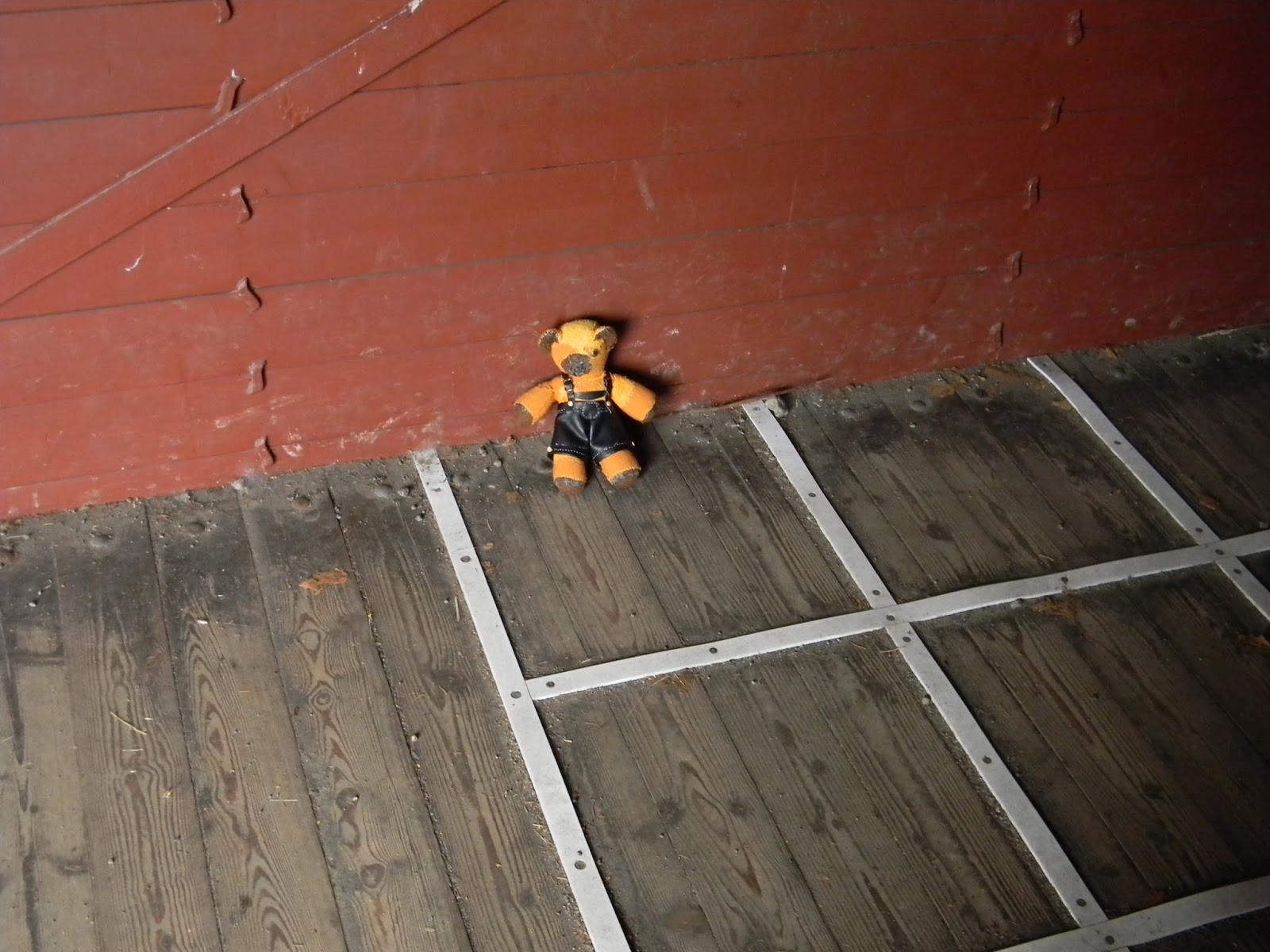
The little square in the top photo shows how much room each person got on the cattle car.
Enough room for a little orange teddy, but for 60-80 grown men and women it was not enough
As I told you Anne and her big sister Margot left Auschwitz by train probably in late October of 1944. After an unknown amount of time (likely about a week) they arrived at a small train platform on the 3rd of November. They were told to get out of the train and then forced to walk approximately 5 kilometers (three miles) to the camp. 

We are not seventy yet! (art by Zsuzsa Merényi, a Hungarian Jew who survived)
People were ill, underfed, cold, underdressed. They had to march, but basically could only drag themselves forward. It was a long slow procession to the camp. 

The camp was originally built to house the German workers who were building the military camp a short distance away. Once the war broke out, French and Belgian prisoners of war were sent there. Soon followed by Russian prisoners of war. The difference in treatment was terrible. The French and Belgians got food, a roof, medical care. There were only 600 of them. There were 21,000 Russians, surrounded by barbed wire and not much else. No shelter apart from the shelter they dug themselves, hardly any food, and no medical care.

Even though the camp is mostly known for the Jews who were killed,
they 'only' numbered a few thousand. Many more Russians (25,000), Poles (15,000),
resistance fighters and political opponents were killed here.
More people arrived: political opponents and resistance fighters. Thousands from all over the occupied territories were killed. Jews were there too: those who might get exchanged for imprisoned Germans in allied countries, those with 'foreign' passports or papers: Spanish, Portugese, (South) American and eventually those coming from other camps.

Anne wrote this while in hiding
As we know Anne had scurvy before leaving Auschwitz. Overcrowding, underfeeding, lack of medical care, bad sanitation and bad housing (like tents and bad baracks) wouldn't help her get better. And she didn't. In fact, she and her sister probably contracted typhus due to the lack of everything. 

NOT their grave, only a memorial stone
Their exact resting place is not known
I think the only thing that kept them going was being there together. In April 1945 the British arrived to horrifying scenes of dead and dying people. In fact, in the month after the liberation 13,000 people died, their only solace probably that they died as free people. Anne and Margot never saw the British soldiers or freedom. They were killed in February 1945, two months before liberation. Anne was 15, her sister Margot was 18 or 19. 

One of the 13 mass graves in Bergen Belsen
Only ten thousand or so names are known of all the victims.
Many more found their last resting place here.
Of the eight people hidden in the 'Achterhuis', only one survived, Anne's father Otto. Anne's mother was killed in Auschwitz in January 1945, her sister Margot in Bergen Belsen in February 1945. Hermann van Pels was killed in Auschwitz in October 1944, his wife Auguste was killed while on her way to Theresienstadt (Terezin) in April 1945, their son Peter was killed in Mauthausen in May 1945, only three days before liberation. Fritz Pfeffer was killed in Neuengamme in December 1944.

Wednesday, 14 September 2016

Brom follows Anne

Coocoo

Do you remember Anne? I wrote about her a few days ago, when we went to visit the first camp she was sent to after they were discovered in the 'Achterhuis' in Amsterdam. As I said, she and her family and her other housemates left on the very last train to leave Westerbork and were sent to Auschwitz.

Auschwitz I with its brick baracks and high voltage barbed wire fences
There were three areas in Auschwitz. The original part or Auschwitz I, where mainly Polish nationals and Russian prisoners of war were held, but also Jewish prisoners. They were basically forced to work and starve, since especially the Russians and Jews were viewed as sub species. But it was in this camp the first working gas chamber of the area was made, using Zyklon B.

Entrance to Auschwitz II (Birkenau)
The train entered through the gate under the tower.
Auschwitz II (Birkenau) was the main Jewish camp, which became known the world over as the extermination camp. Several large gas chambers and crematoriums built especially to eradicate the Jews of the world. And then there was Auschwitz III (Monowitz) which was built especially to house workers for the IG Farben factory, since the main camp was too far from the site. Plus there were about 45 bigger and smaller subsidiary camps in the area, most catering for the industry. 

The 'station' on the right hand side.
Selection took place right where the group of people is.
When Anne and her family left Westerbork on September 3rd in 1944 they were put into cattle cars and together with about 1,000 other prisoners they travelled for 2 days before arriving at Auschwitz II (Birkenau). As soon as they got off the train they were forced to make two lines: men and older boys on one side and women and children on the other side. Anne could probably not even say goodbye to her father, before he was forced to stand on the left, while Anne and her sister Margot and her mother were forced to the right. 

'Planned' for 7-8 people to a bed, but it was more common for more, anything up to 20.
Most of the prisoners who arrived were killed within 1 hour of arrival, but Anne and her sister and parents were 'lucky', they were deemed fit enough by the doctor to work and they were sent to the camp instead of to the gas chambers. Father to Auschwitz I and the women stayed where they were. 

Twins got 'special' treatment. Here two 15-year old Polish girls.
It must have been strange for Anne to enter the barack where she would spend her time. Instead of a bed, there were bunks, the lower ones being on open ground. Sharing with a lot of other women and girls, sometimes so many that if one person turned, all the others had to turn as well. 

An original drawing on one of the walls in a washroom at Auschwitz I
There were lice and fleas, other creepies and rats as big as cats, that fed themselves on the dead and even on the living at some point, because they were too weak to fight them off. After a short while Anne developed scabies and was put in the scabies ward, which was separated from the camp by a high wall. Margot went with her. That was probably the last time they saw their mother, because only 6-7 weeks later a train left for Bergen-Belsen and it is very likely Anne and Margot were on it. Their mother died in Auschwitz II in January 1945.

Count the towers going off to the right. They just seem to go on and on!
Seeing the site for ourselves was incredible. Seeing the documentaries and films doesn't prepare you for the sheer scale of Auschwitz II (Birkenau). Most of what is standing right now are chimney stacks, but even then it is mind blowing and scary. Eighty percent of people arriving were killed within an hour of arrival and never stood a chance. 

Write your name on your luggage, so you can get it back after the 'shower'
Of course they never did and the contents were sorted and sent to the Reich..
Mothers and children, old people, the handicapped and everybody the 'doctor' thought was not fit enough for work. And even if they did survive that first hour, sleeping on the cold ground, living on meagre rations, being worked to death, being forced to stand in the cold for hour upon hour killed many more. 

Two chimney stacks to every wooden barack
As with Westerbork I didn't want to be in any photo and felt sorry especially for all those children who never got the chance to cuddle a teddy, to go to school, to swim in the river and to enjoy their childhood the way they should. 

Polish teachers and doctors, locksmiths and farmers.

Friday, 9 September 2016

Brom and Anne

Coocoo

Today was our first day of the road trip and boy, have I seen a lot of road! In fact we saw about 10 kilometers of it for an hour and a half! When there was only an hour left to go to the hotel, so not good!

But, it started off good. Well, serious anyway, because it wasn't good. You may have heard of a girl called Anne Frank. She was a little German girl who came to live in the Netherlands in 1933 when her family started having difficulties in Frankfurt in Germany because they were Jewish. She was happy and healthy and enjoyed school and friends. And then Hitler invaded the Netherlands and all Jewish people were banned from a lot of things. She couldn't go to the swimming pool anymore or to the cinema. She had to go to a Jewish school and she had to wear the Star of David with the letter J in it to make sure everybody knew she was Jewish. 

One of the watchtowers
And then in 1942 all the Jews were told to report themselves to the police so they could be transported and live together in special work camps. Anne's father didn't believe that and made sure he, his wife, his elder daughter Margot and of course Anne were hidden behind the closet at work. Others soon joined them. By that time Anne had gotten a diary and wrote very often in it about her life and her dreams and all that is normal to think about when you are a teenager. 

And then somebody ratted them out. They were all picked up, taken to the police station in Amsterdam and after a few short days they were put on a train to Westerbork, in the east of the Netherlands. There were a lot of other Jewish people there, as well as a few Sinti/Roma (gypsies). The camp had been built in 1939 to deal with all the fleeing Jewish refugees from Germany, while they were waiting for visas to the United States or other countries. The Germans took over in 1942 and the refugees became inmates.

Cattle trucks were used for the transports
Most of the people in the camp didn't stay long. From July 1942 a total of 93 transports to Auschwitz, Sobibor, Mauthausen, Bergen-Belsen and Terezin (Theresienstadt) left Camp Westerbork. Over 100,000 mothers and fathers, sons and daughter, aunties and uncles, friends and neighbours were sent East. Around 5,000 survived, but most were killed on arrival at their destination. 

When Anne and her family arrived at Westerbork, they were put in the penitentiary part of the camp, reserved for those who had tried to hide. They were always quick to send those off and Anne's family was no different. They left on the very last train to leave Westerbork in September 1944 and sent to Auschwitz. 

As a teddy it is very hard to understand why people aren't nicer to each other. I am orange and I know of brown and white and pink and yellow and purple teddies and everybody loves those. Some of us have bows and ribbons, others make noise, but we are all loved. So, to be singled out because you have a different faith or colour or purple feet is not good. 

The Star of David for all the Jewish victims, the little flame for all the Roma/Sinti victims and the empty ones for the people from the resistance. 
Even though there wasn't much left of the camp, it was a depressing place. And I didn't want to be in any photos either, knowing that most of the people had everything taken from them, including teddies and dolls.

We will be visiting two more camps during our road trip. But fortunately we will also be seeing a lot of other stuff as well. Because tomorrow we will be leaving Germany (where we are right now) and head into the Czech Republic!

Monday, 11 May 2015

Freedom

The orange wasn't used that much during the war. 
But once liberation came: it was everywhere!
During the past week I have seen several documentaries, films and memorial services about the Second World War. Every time equally impressive, thought provoking and at times even scary. The diaries and letters written by Heinrich Himmler were of the latter variety. They were chilling in their 'niceness'. 

Today I saw the VE* 70 celebration on the BBC. Very impressive to see all those veterans come past. They fought for the freedom in Europe. The only problem I had was when at one point, one of the commentators stated that the British do the 'remembering' the best of all of Europe. As if it were a contest (I am writing this a bit out of context, but it marred).

Male farm labourers were not sent to Germany to work as much as other professions.
The veterans who came past were about the same age my grandparents would have been. My grandparents who lived in a 'neutral' country that had been overrun by the Germans anyway and were suffering. The winter of 1944/5 was especially hard. The Germans had taken revenge on the people of the Netherlands for the help they had given the Americans near Arnhem (Operation Market Garden, a failed operation) and had cut food rations even further. People were eating tulip bulbs to stay alive, but still a lot of people died due to hunger and cold.

My paternal grandparents lived on a farm in the North of the country and weren't so affected by the food shortages. It is in fact quite probable that hordes of people from (especially) the West would come past to get some food to survive. My maternal grandmother however, was far worse off. She was a maid and lived and worked in the house of a notary. And even though she never went hungry, she did suffer the cold. What my maternal grandfather did at that time is a mystery. We don't know whether he worked in the Netherlands or in Germany as a forced labourer as many young men from occupied countries were. Or perhaps he was hidden somewhere and/or working for the resistance. 

The millwhips were used to send out messages during the war. 
My maternal grandmother wrote me a letter for a school project in 1983. Some of you have read it before, others may be new to it, but it is certainly worth reading again. Here is the link. I wish though that I had asked more questions while my grandparents were still alive. Unfortunately I didn't and now the chance is gone (they have all passed away). 

*VE stands for Victory in Europe. VJ would be Victory Japan which happened in August 1945,  three months later.

Thursday, 5 April 2012

'Hands'

I sometimes wonder how they come up with the prompts they come up with, but I looked and looked and even found a quite recent photo that contained a glove. Which is allowed in the 'hand' prompt! Yippee!!

Anyway, I took this photo only two weeks ago in the American Airborne Museum in Sainte Mère Église in Normandy. A lot of those display cases displayed items used for combat and there were a few that contained items used for sports and the like. It certainly doesn't look anything like the gloves we used when playing soft ball in high school!

This is my thirteenth entry for Photo Theme for Thursday. Why not join?

Sunday, 25 March 2012

To hang or not to hang...

John Steele (well, a dummy) hanging from the church
The first stop we had in Normandy was on Tuesday morning. We were headed towards the small village of Sainte Mère Église, not far from the Atlantic coast. On the fifth of June 1944 a fire broke out in one of the bigger houses of the village and as the Germans and French were putting out the fires, all of a sudden they saw parachutists of the American 82nd Airborne Division. Of course the Germans immediately started to man their guns and started shooting at those parachutists. Some died, others escaped and one of those parachutes landed on the church, where he got stuck.

One of the stained glass windows of the church
John Steele was the unlucky soldier who had managed to get himself stuck on the steeple. As he hung there, fights broke out underneath him in the church square and one bullet actually hit him in the foot. He decided to play dead and hung there a further two hours, before the Germans finally got him down. When they saw he wasn't dead, but very much alive, they took him captive and he became a prisoner of war. However, during the next few days, there was so much mayhem and chaos, he managed to escape. He rejoined his company and he lived to fight in both Belgium and the Netherlands. He passed away in the United States in 1969, aged 56.

The film 'the Longest Day' remembers the night before and of D-Day and John Steele features in it as well.

Wednesday, 21 October 2009

N is for...


Nissen hut

Whenever I read books that have their story take place during WW2, they often talk about Nissen huts. And I never knew exactly what it was. Until I went to the Imperial War Museum Duxford (England) earlier this year and as well as all the old aeroplanes, there was this hut. And it turned out to be a Nissen hut.

So, what is a Nissen hut exactly? Well, it is a hut invented and built for housing troops during WW1. Due to its semicircular shape, the hut deflected shrapnel and bomb blast, making it a perfect bomb shelter. It is the first pre-fab building and it would fit on the back of a three-ton truck. It's built up of a metal frame, covered with corrugated iron. The door is made of wood and the windows are not glass, but oiled cloth. Six men could have it standing within two hours!

They were used for housing troops, kitchens, Mess rooms, storage rooms, bathrooms, small hospitals, stables and of course bomb shelters.

The hut was invented in 1916 by Peter Nissen, a Norwegian American who joined the Royal Engineers during WW1.

For more N words, please check out ABC Wednesday and join in the fun!

Update: the Quonset (USA) and the Romney (UK) hut are both derived from the Nissen hut.

Tuesday, 5 May 2009

Freedom


Today it's Liberation Day in the Netherlands. We remember and celebrate our liberation from the German oppression during the Second World War. Years ago, when I was still in primary school, we had to do a project: ask one of your grandparents about World War II. I knew that one set of grandparents had hidden someone from the Germans (they lived on a farm), but thought that would be a bit much to ask. So, I asked my other grandmother (Oma) about her experiences. She wrote me a letter back and my dad translated it into something legible (her handwriting was awful). Everything in brackets is added by me. Here's my Oma's story:

It was the end of December in 1942 and we had nearly run out of food. During the day I worked at a notary's in Utrecht (middle of the country) and during the evenings and at the weekends I stayed at an aunt's place. She had relatives in Dalfsen (east of the country). And they still had plenty of oat, rye and potatoes. And of course they clandestinely slaughtered a pig every now and then. But how to get that food to Utrecht? After a short deliberation and the cooperation of a brother of Uncle Kees (who was in the resistance), we were able to borrow a handcart from him to get some things. There was also a male cousin who would come along. A rather large and course guy. He would come dressed as a woman. It wasn't quite without danger though. In those days all boys and men were supposed to go to Germany to be put to work.

We left Utrecht at 6am on January 5th 1943. We couldn't leave earlier due to the curfew. The weather was beautiful. Not very cold and no rain. We moved from Utrecht to De Bilt to Bilthoven, Den Dolder and Amersfoort. Arriving in Harderwijk we passed the TINO soup factory. There was a Red Cross post. We had to check in and received a lovely cup of soup. It tasted so nice. I can't quite recall where we spent the night. Nowhere was there anything for sale. We could have taken something from home, but that wouldn't have been enough for the trip.

In the mean time we had arrived at the IJsselbridge (near Zwolle). There were a lot more people on the way to get food. But to get onto the bridge with the handcart was impossible. In the mean time about eight to ten handcarts had gathered. The decision was made to try and cross the bridge together. There were also elderly women. But most were young girls. And Germans everywhere. We were halfway on the ramp to the bridge when all of a sudden a harsh voice sounded: "Halt ein mann bei" (Stop, there's a man as well). The girl in front of us turned around and said, we are being called. I snapped: "Shut your face, move it!". Because that woman was my cousin. And he had to get across. They let us cross. And that's how we crossed the river IJssel.

We still had to get to Dalfsen though. We got there at around 7 pm. We were both exhausted. It had taken us two days. We stayed there several days. But it had started to snow. There was a meter and a half (5 foot) of snow. Never before, nor after have I ever seen so much snow. But we had to get back to Utrecht. Again in convoy across the IJsselbridge. This time the Germans left us alone. We had home-made bread and bacon for the road. And we had potatoes, rye, oats and eggs. The way back took us four days. The journey was a lot harder. Because of our load and because of the snow. Afterwards we slept for like two days in a row. And we shared the food with others.

During the summer I took two nieces to Dalfsen. Because it was harder to get food in the city. We walked all the way and had one bike with massive tires (all the rubber tires had been confiscated by the Germans and it was either wooden tires or metal tires). But the three of us and luggage on one bike was hard. So, walking it was. On our way we spent a night in a haystack of a farmer. For my way back I was given another 35 kg of rye. This time the Germans did check at the IJsselbridge. But I was allowed to pass. After that I went to live at the notary's, for days and nights. And he occasionally received some food. I've never known true hunger, but I did know cold.

Langerak, 3 May 1983

The total trip was about 110 kilometers (around 70 miles) one way (taking today's motorways)! If you click on the map, you can see a line going from Utrecht via Amersfoort and Zwolle to a point just beyond Dalfsen. That would roughly have been their route.