Showing posts with label NOP. Show all posts

Sunday, 10 May 2015

Photo on Sunday 2015-16

During my recent short holiday in the Netherlands, I spent one day visiting with old colleagues. Which was great fun of course! But I had left a bit earlier, so I could take photos of the tulips and blooming apple trees. And then I came across this. A blue and white pole with a red/orange plane on top.

I have posted something similar several years ago, but with ships on top. Here's the link. And basically it's the same as with the ships, except with planes. Now, I saw two of those plane poles, but there are several more. Because during WWII several planes didn't make it back for whatever reason and 'landed' in the NOP in the Netherlands. And since that area had only just become sea-free (1942), they were easily visible. 

Wednesday, 17 October 2012

N is for...

Nagele

Nagele is one of the ten 'green' villages surrounding the town where I live (Emmeloord). It isn't big, but it has one feature not found anywhere else in the Netherlands: all the buildings have flat roofs!

After the North East Polder was formed in 1942 by closing the last of the dykes, people started to dig ditches (by hand) to get rid of the remaining water in the polder. They planted crops that would help with the drainage as well and after a few years some small settlements started: Emmeloord, Marknesse and Ens, the latter two also being two of the ten villages, albeit the two largest. Here there were baracks to house the men who worked the land and the infrastructure. 

After the war, work started in earnest, the first houses went up in those three settlements and the first farms were built, attracting farmers from all over the country. The village of Nagele and the other villages started their life then as well. Since all the villages in the area were going to be completely new, it was of course a great place for architects and even though Nagele today is different from the original plans, there are still quite a few things that are the same, amongst which of course the flat roofs. Another original plan was the large common with three schools (Protestant, Catholic and Public) and churches. Even though the common and its buildings still exist, due to the smallness of the village, one of the churches is now a museum and the schools have joined up as well. 

And if you want to know what the other 'green villages' are called, here they are: Ens, Marknesse, Kraggenburg, Luttelgeest, Bant, Rutten, Espel, Creil, Tollebeek and Nagele. None of the villages are any more than 20 km removed from Emmeloord. All of the villages are named after former areas or villages on or in long forgotten places. 

This is the letter N for ABC Wednesday. Why not join?

Thursday, 12 July 2012

'Movement'

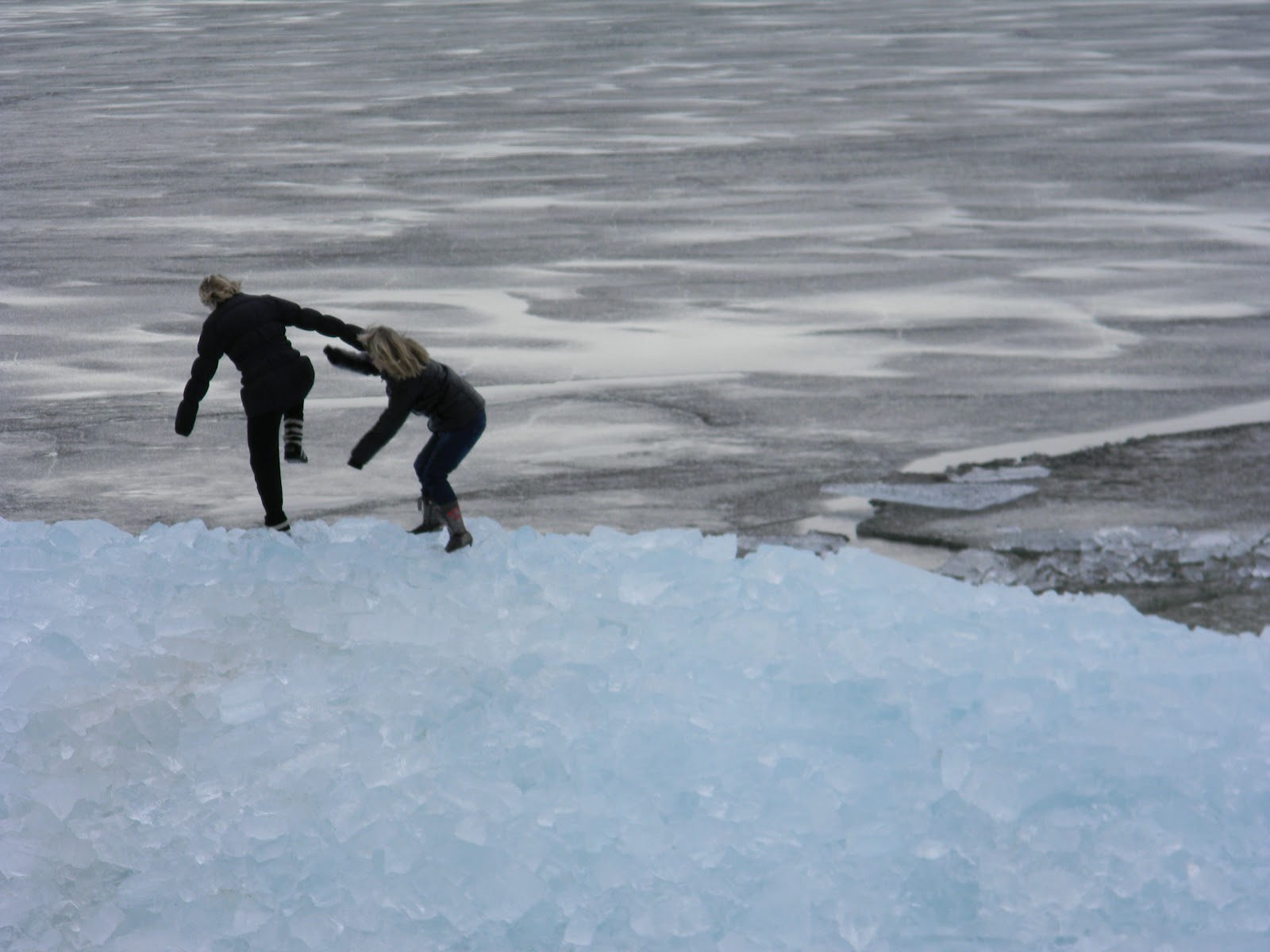
I have liked this photo ever since I first took it back in the winter. The two girls were trying to walk on ice and not the flat ice either. Due to the wind and the thawing of the ice, it had broken up and then amassed in great big mountains near the coast of Urk. It was absolutely freezing cold due to the wind and because the surface was so uneven, it was actually pretty dangerous as well. I think the girls managed to stay upright though, although this photo might suggest otherwise!

This is my 27th entry for Photo Theme for Thursday. Why not join?

Thursday, 28 June 2012

'Wooden'

I live in a country where there are rivers and a lot of clay which results (or can result) in bricks. That's why most houses and businesses in the Netherlands are actually built of brick. Nice red brick. But not all houses are made of brick. Actually in the North East Polder where I live, there are several locations where there is a smattering of wooden houses.

These houses are not Dutch, they are in fact Austrian and were gifted to the Dutch shortly after the Second World War as part of a repayment scheme to provide the Dutch with houses. Most of those houses are found in the villages of Ens, Marknesse and Emmeloord and the rest are out in the country where they are part of farms.

This is my 25th entry for Photo Theme for Thursday. Why not join?

Saturday, 18 February 2012

The big freeze

The lighthouse of Urk
About two weeks ago the big freeze arrived from the East, bringing a bit of snow and a lot of freezing cold weather with it, which almost resulted in an 'Elfstedentocht', a 200 km long skating race past the eleven cities of Fryslân. Unfortunately by the time the ice was finally growing into thick enough ice, thaw set in and the idea had to be put back in the freezer (pun intended). But, I am not going to talk about that today, I will however be talking about what happens after the big thaw sets in.

The flats with the ice pile-ups
Because once it starts to thaw, the ice in rivers and lakes starts to break up. If there is then a westerly or easterly wind, the waves created by said wind will push the ice up onto the shore. Stronger wind equals higher waves equals higher ice pile-ups. It can actually come as high as the dykes and villages on those dykes! Now, I had only ever heard of it happening, but had never actually seen it. So, as I was travelling on the bus home today, I decided to not get off at my stop, but stay on until the next village (Urk) and walk up to the lighthouse and see this pile-up of ice with my own eyes.
Trying to stay upright!
I had been warned by the busdriver that it would be cold and my jellybean, was he right: it was freezing! Even though the temperatures have been way above zero for about a week now! But with the wind coming from the west and coming over ice, my hands soon felt like blocks of ice themselves. It was great to see though. People had come from all over to see them and were scrambling over them and past them and taking photos.

Ice pile-up up close
After only ten minutes however I felt like one of those blocks of ice and decided to go home, where it would be nice and warm!

Friday, 1 October 2010

NOP 8


The replica of a bridge built between the north and the south. What's now grass used to be water!
I've written about Schokland before in this post in which I told you how it stopped being an island. But when it still was an island, island life was hard. The people on the island were poor and the chance of flooding was great. Most of the people on the island made their living of the sea, meaning they were fishermen, some had shops or had a bit of farmland where they would grow wheat.

Over the years the island had been battered with flooding so often, that it almost became two islands, only a small strip of land existing between the north and the south side. Since that strip of land was quite low lying, it was dangerous to cross and they constructed a bridge. The bridge wasn't very wide, in fact there was no room to walk side by side.

The Schokker Dance
However, people crossed the bridge from both sides (and in all types of weather) and sometimes needed to pass each other. And that's when they did the Schokker Dance. You grabbed hold of each other and turned. This practice was very popular with young men and women of course!

Thursday, 26 August 2010

NOP 7

You could be mistaken in thinking this is a church tower. But it's not. It is in fact a (former) watertower. We call it the Poldertoren. It's octagonal and it's the result of a contest for architects. This design won and was subsequently built. Right at the top there is a 'carillion' or Glockenspiel, which is not solely for churches in the Netherlands.

Nowadays it houses the Information office and a restaurant. And you climb to the top to see the view (which I have yet to do).

Thursday, 22 July 2010

NOP 6

The NOP was only formed in 1942, when the last dyke was closed and the drainage could start. The Germans didn't mind young men working in the NOP (the last dyke was closed in the middle of WWII), since they also realised the need for new agricultural areas to feed the people. By the end of the war, there were several worker's camps in the polder, where young men lived in relative freedom. They had to dig ditches, build roads, plant trees and whatever else was needed to make this polder habitable.

After the war ended, those camps continued to exist, but with more and more land 'done up', there was more need for houses than baracks. However, a lot of people needed housing in the Netherlands and materials to build houses wasn't always easy to come by. Part of the problem was then solved by the Austrian government who donated houses to the NOP. Austria of course had been (a willing?) part to the German Third Reich and wanted to make amends.

These houses can be found in the main town/village of Emmeloord, two of the larger villages (Marknesse and Ens) and even next to the oldest farms. Made of wood, they are still quite a sight in the NOP, since the houses in the Netherlands are usually made of brick.

Thursday, 17 June 2010

NOP 5


This is called the Little Polder House and is a piece of landscape and motorway art. It was only after it was erected that they realised the size of the house fitted perfectly in the NOP. The short sides of the house are three meters and the long sides are eight meters. The plots of land given out to the first farmers were three hundred by eight hundred meters or a multiplication by two or three of that.

The little boat on top of the smoke has two functions. First of all it shows you where the wind comes from. And the second function is a bit more morbid. If there were no dykes surrounding the part of the country I live in, the little boat would be floating on top of the water instead of the smoke!

Thursday, 10 June 2010

NOP 4

When these things first appeared in the NOP, I wondered what they were. A few weeks later it was finally in the papers: every time you see one of these poles, it means a ship wreck was found close to it. Most of these wreck poles were found around the former island of Schokland. When Schokland was still an island, Lake IJssel was the Zuiderzee, or an inland sea. The weather could get really rough and many ships barely made it back to port.

Thursday, 3 June 2010

NOP3

I must have passed this tower hundreds of times and always thought it was a water tower. Until I saw the sign attached to it and learned it had nothing to do with water. It was actually a guard tower.

During the Cold War (fifties and sixties) towers like this sprung up all over the Netherlands and the rest of Europe. They had someone in the top scouring the air with a pair of binoculars to spot for foreign (read Russian) planes. From the late sixties they became obsolete and most of them were demolished. This one survived and you can get the key off the bridge guard and you can climb all the way to the top to spot for foreign (read Russian) planes.

Thursday, 27 May 2010

NOP 2

Tulips, windturbines and the dyke to keep the water from Lake IJssel out. Quite an ordinary view for me...

This is the second installment of my 'see where I live' series.

Thursday, 20 May 2010

NOP 1

Since I've got my parents' car on loan while they are on holiday in the Middle East, I can do a lot. I drive to work every day (I'm lazy), I can get the shopping in a lot easier and I can drive around the countryside.

I live in the Noordoostpolder, which is the oldest part of Flevoland, the newest of the twelve provinces in the Netherlands (hence the NOP in the title). It's a mainly agricultural area, with tulips and potatoes the two crops that stand out (and both have their own festival as well).

This photo shows you a field of tulips that have just been beheaded. Most flowers have lost their heads due to the machine, but some were either too small or had not yet bloomed. The reason the flowers are beheaded (as opposed to deadheaded) is basic: stop the nutritions from going to the head and lead all of it to the bulb. The bulbs are then harvested some time during the summer, teenagers peel off the outer layers and the bulbs will go up for sale.

Thursday, 10 September 2009

Spuds


The medieval jousting tournaThe Potato 2009 venue

Doesn't it look fun and well, ehm, even more fun? All those tents are actually up about 5 minutes walk away from where I live and they are for the Potato 2009 event! Every four to five years the town where I live will hold a massive potato related fair. If you have anything to do with farming potatoes on a large scale if you're from abroad or a smaller scale if you're from the Netherlands, chances are you will have heard of Emmeloord!

When I took the photo this morning, the cycle path was hard to cycle on due to all the people not bothering driving to the official parking lots, but parking in the grass on either side of the cycle path. Just so they won't have to wait to get on a (free) bus! However the cars that were there came from a variety of countries: the Netherlands, Germany, Belgium and France were only a few I saw.

In 2000 and 2005 they also had massive fairs and people came from as far afield as Russia, Argentina and Canada to come to my small hometown to see what was new in the potato field. The first time was the busiest: it was raining, so Dutch farmers couldn't be bothered to farm and came in droves! At the end of that week, you could grow potatoes in my coach!!! This year, we're not doing the transport side of the fair though. So, no potato-farming in the bus.

This fair is not the only thing organised because of the potato. The Spud-festival started on Tuesday and is going until Sunday. We will have a Fish-Potato run on Saturday (From the fishing village of Urk to the potato village Emmeloord), a cycle tour, free chips/fries/frites/patat on Saturday, a concert and lots of other stuff! I will have to work the whole weekend though and will not be able to see or do anything (and before you ask: no, I wasn't planning on doing the run).

Fact: Belgium created the autumn school break in order for children to help their families with the potato harvest!

Wednesday, 15 July 2009

Z is for...


Welcome to the bottom of the sea

Zuiderzee

When people (especially Johnny Foreigner) ask me where I live, I usually say I live on the bottom of the sea, making me a mermaid. Well, the mermaid part might be a bit of a stretch, but I do live on the bottom of the sea. Of course it isn't a sea anymore, otherwise I would have to seriously learn how to live under water or move away, but it used to be a sea.


The situation in the past, the red cross shows where I live now, click to enlarge to see!

In the nineteenth century the population of the Netherlands was growing and there wasn't that much space. So, the ideas of closing the sea and turning it into a lake and making land in that land were taken out of the cupboard again. It wasn't the first time this was thought of and indeed it wasn't the first time it was done. Most of the west of the country used to be water at some point or other, before being dried out by man (and windmills) and put to use as land. But this was going to be the most ambitious project yet!

The first thing they needed to do was close off the sea. It was only an inland sea, but it had an open connection with the Waddensea and the Northsea beyond. After a massive flood in 1916 parliament finally passed the law to close it off (it had been on the shelf for 30 years) and work started in 1920 on the Amstelmeerdijk. When that was finished, work started on the first and only Zuiderzeepolder: Wieringermeer, named for the island Wieringen which would be incorporated into the new polder*. Work was finished in 1930. Two years later the Afsluitdijk(Closing Dyke) was finished, turning the salt/brackish water of the Zuiderzee into the fresh water of the IJsselmeer (Lake IJssel). The sea was no more...


The current situation with the finishing dates; the little black cross shows where I live.

The Noordoostpolder (North East Polder) was the first IJsselmeerpolder and was finished in 1942. It incorporated two islands: Urk and the empty Schokland. After the war two more polders were formed: Eastern Flevoland and Southern Flevoland, the last being finished in 1967. In 1976 a dyke was created so a new polder could be formed (Markermeer), but during the 1980's those plans were put on ice indefinitely.

For more information please check out this Wikipedia article.

For more Z-letters from around the world check out ABC Wednesday and join in the fun!

*) Polder: tract of low land, especially in the Netherlands, reclaimed from the sea or other body of water and protected by dykes. In the olden days kept dry by windmills, nowadays more usually by diesel operated pumping stations.

Wednesday, 18 March 2009

I is for...

Island

Now, you're probably looking at this photo and thinking: she's lost it! She's gone completely doolally if she doesn't know the difference between an island and a small mound in the land. Well... you would be wrong. Of course I know the difference, but in this case, it actually IS an island. An island in the land. It used to be an island in the sea, but they built a few dykes and pumped all the water out and hey presto: an island in the land!

This is Schokland and it's one of the oldest parts of the area I live in. Most of it (including where I live, about 15 kilometers away) was only made after 1942, but Schokland was there way before. The island changed shape continually due to the sea: flooding and loss of land were a given and in the end, there was only a very narrow bridge between the northern and southern part. All the flooding also meant that on quite a regular basis people would loose their lives. In 1859 the government decided to close down the island, forcing all islanders to demolish their houses and leave. The only things left were the church (the bigger building) and the keeper's house. Irony of irony: after everyone left, there weren't anymore floods and the island stayed the same size until 1942!
Nowadays the island houses two farms (new) and a museum. Some houses have been rebuilt as part of the museum and it has made the Unesco World Heritage list. Most of the skirting of the island was used for roads in the newly made polder and there's even a road named after it: Palenweg (Poles Road). There have been some problems with the island sinking due to bad watermanagement, but they are working hard at combatting those problems.
So you see: I haven't gone doolally and it is (was) an island!

For more I words please check out: ABC Wednesday