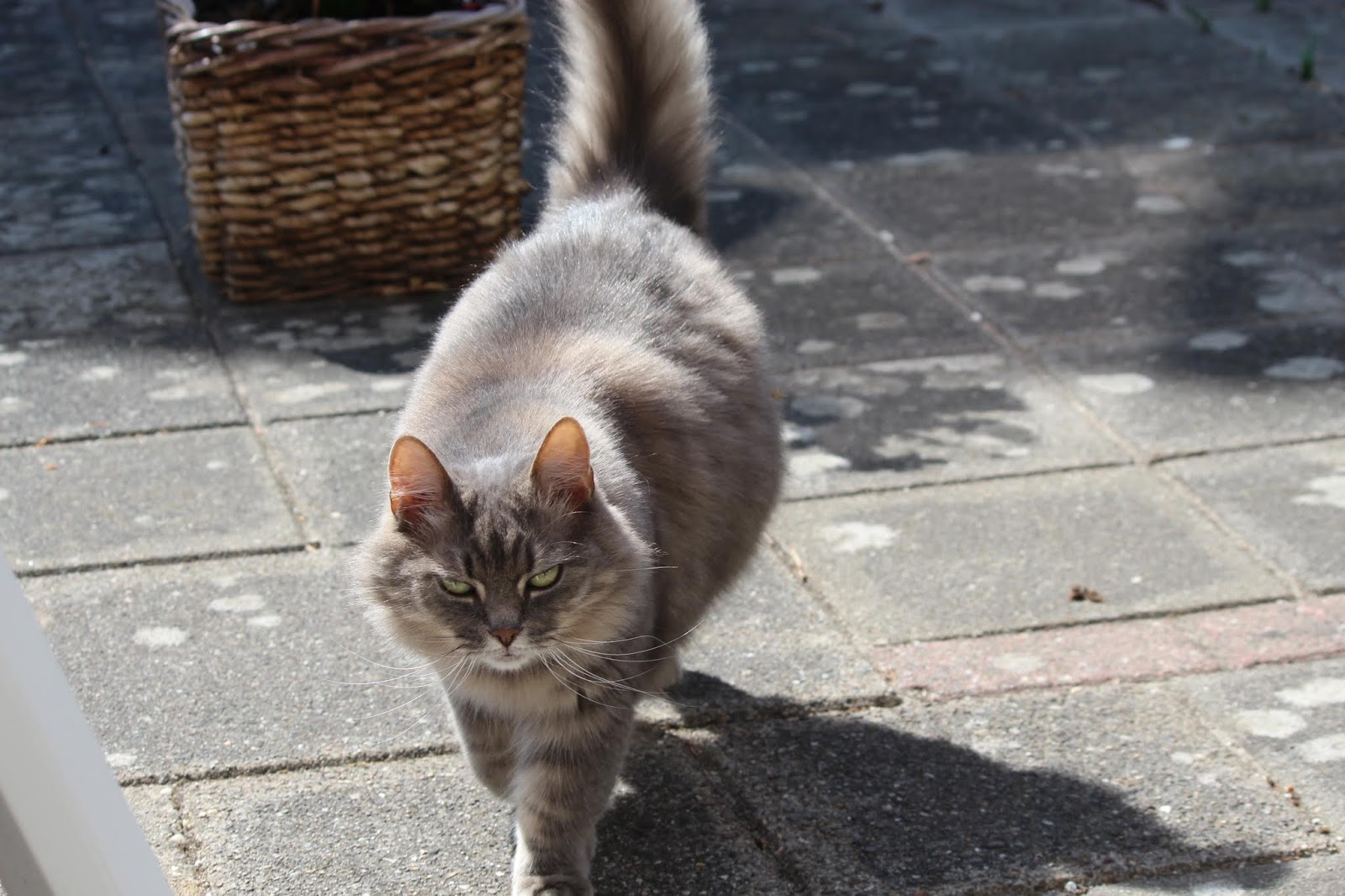
Miaow
Wow, it has been a long time since I was allowed here. I know Mara sometimes tells you a bit about me, but I think it's very important to make sure I do tell you about the MBF in the WWU myself. Just so you won't forget...
 |
The tree in which they reside we think
look closely and you can see an adult great tit |
And today I will tell you all about my hunting skills. Because this week I didn't catch one, but two birds! The first one was a baby great tit (oh, Mara told you about it), but Mara took it from me and after that I wasn't allowed out anymore that day.
 |
| Chittering on the fence |
Yesterday I was sitting next to Mara in the garden and there was another great tit just chattering away to us. It was hopping from one end of the fence to the other and back and just chittering and chattering. I didn't move a muscle, although I would have liked to have caught it, I can tell you.
 |
| You just fly, I will catch you someday! |
Today I was allowed out again because the weather is quite nice right now. And all of a sudden I saw another little birdie. With an almighty jump I caught it and brought it in. Where Mara got hold of me and locked me in the kitchen! And when I came back out the birdie was gone. I will have to catch another one now to play with...
 |
| The first great tit |
Note from the editor: the first baby great tit was very alert and very determined to get as far away from my hands as possible. As it was fledging anyway, I put it in the garden and crossed my fingers for a safe return to its parents.
 |
| It looked really sad in my dad's hand |
Alas the second baby great tit was perhaps fledging (as it was on the fence where Miss Oswin caught it), but after being caught it was definitely not alert. It barely moved apart from breathing. My dad put it at the other side of the house near a garden wall, where we hope it will be okay, although Miss Oswin isn't the only feline roaming the streets here and it was in a fairly bad state.